24/7 emergency line in Austin, TX
Leak Detection Austin, TX: Find the Leak Before It Finds Your Foundation
If your water bill jumped for no reason, there's a warm patch on an otherwise cool floor, or you can hear water running somewhere in the house when everything's off, you're probably not imagining it. This city's clay soil, its freeze-and-drought weather swings, and a lot of plumbing that's older than people think all work against you at the same time.
We find hidden leaks (slab leaks, underground service-line leaks, and leaks inside the house) using acoustic listening equipment, pressure testing, and other non-invasive methods first, so nobody's cutting into a slab or digging up a yard based on a guess.
24/7 emergency line. Call and a person answers.
Why Austin Homes Leak More Than Most Cities
This isn't marketing talk. It's three separate, well-documented things stacking on top of each other.
Expansive clay soil
Much of Austin sits on Blackland Prairie "black gumbo" clay that swells when wet and shrinks when dry, shifting a foundation by inches in a single season and stressing the pipes below until a joint separates.
Drought, then downpour
Austin gets stretches of drought followed by heavy rain, accelerating the clay's expand-shrink cycle. A leak makes this worse too, because it saturates the soil further and the foundation moves more.
Occasional hard freezes
Austin plumbing is built for a mild climate, so when a real freeze event hits, like February 2021's Winter Storm Uri, pipes take real damage here on top of what the soil's already doing to them.
Older housing stock
Central neighborhoods like Hyde Park (78751) and Clarksville/Tarrytown (78703) still have homes on original cast iron, galvanized steel, or early copper plumbing with a real, finite lifespan.
Where We See It Most
Leak patterns aren't identical across Austin. The city's geography genuinely isn't one thing.
East & Central Austin
The flatter ground around Hyde Park, Clarksville, Travis Heights (78704), Zilker (78704), Mueller (78723), and South Congress sits squarely in the clay-soil zone, on top of older housing stock.
West of MoPac
Hillier, limestone-dominant terrain along the Balcones Fault Zone means different rock, different drainage, and a different failure pattern, though no less real.
Fast-growing suburbs
In Cedar Park (78613), Pflugerville (78660), and Round Rock (78664/78665/78681/78682), newer PVC/PEX plumbing doesn't solve the problem. It's the ground moving under the house, not the pipe material.
How We Actually Find It: Not Guesswork
Meter & shutoff test
Everything off, main valve shut. If the meter's still moving, the leak is in the service line or under the slab.
Exterior perimeter check
Every pipe stub-up, hose bib, and irrigation connection gets checked before anyone steps inside.
Acoustic & ground mics
Water escaping under pressure makes a specific sound specialized listening equipment can pick up, even through concrete.
Cross-confirmation
We don't mark a cut or dig spot off a single reading. A second method confirming the same location is standard procedure.
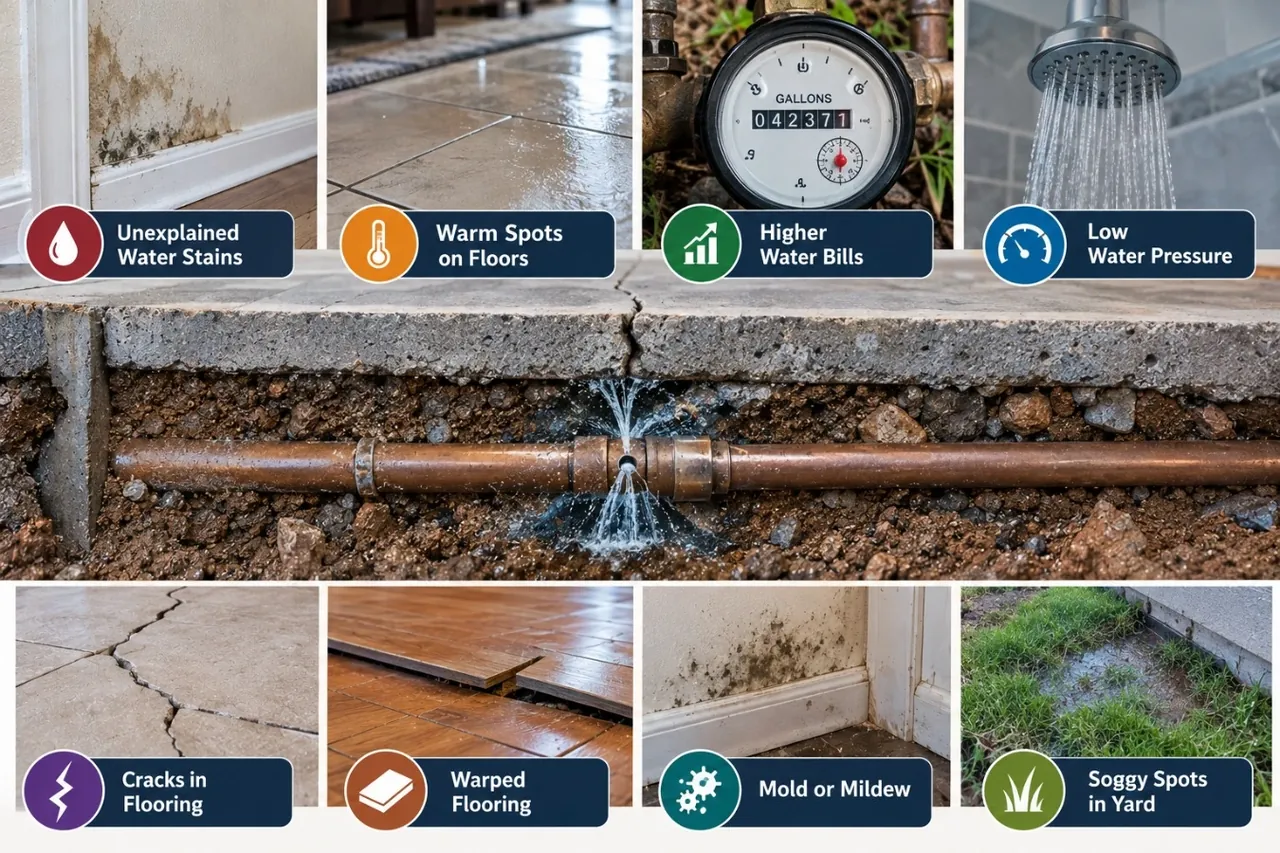
Signs You're Dealing With a Hidden Leak
- A water bill that jumped with no real change in usage
- A warm or hot spot on an otherwise cool floor (see our warm-spot guide)
- The sound of running water when every fixture is off
- A water meter dial that keeps spinning with everything shut off
- Soft, soggy, or unusually green yard patches, even in dry weather
- A musty smell or visible mold near flooring or baseboards
Austin Water Handles the Street Side: We Handle Everything From the Meter In
Austin Water is responsible for the public water main up to your meter; everything from the meter into your house, the service line, the shutoff valve, the slab, and the interior plumbing, is on you. If you think the issue might be on the city's side, Austin Water's dispatch line is 512-972-1000 for emergencies and 311 (or 512-974-2000) for non-emergency reporting.
Austin Water also runs a Water Leak Adjustment program that can credit part of a bill spike caused by a qualifying leak, and the City of Austin Housing Department has a separate Plumbing Repair Program offering grant funding for qualifying households. Both are worth knowing about once a leak's been found and fixed.
Our Services
Every leak-detection service most Austin homes and businesses need, handled with the same test-before-you-cut approach.
Slab Leak Detection
Our most-requested service, using acoustic and pressure testing before anything is cut open.
Learn more →Slab Leak Repair
Spot repair, re-routing, or trenchless options once the leak is accurately located.
Learn more →Underground & Water Line
Yard, main-line, and service-line leaks found with ground mics and line tracing.
Learn more →Residential Leak Detection
Whole-home detection, not just slab leaks: fixtures, water heaters, irrigation, and interior walls.
Learn more →Commercial Leak Detection
Built for multi-meter, multi-building, and high-volume properties with minimal disruption.
Learn more →24/7 Emergency Leak Detection
Active leak or flooding right now? A 24/7 emergency line, day or night.
Learn more →Leak Detection & Repair
Detection and repair handled as one job, start to finish, with one point of accountability.
Learn more →Non-Invasive Methods
Acoustic, pressure testing, thermal imaging, and line tracing, all before any cutting or digging.
Learn more →Service Areas
Austin proper, plus the fast-growing suburbs with their own dedicated coverage, and the central Austin neighborhoods in between.
Central Austin neighborhoods we also cover: Hyde Park, Clarksville, Tarrytown, Travis Heights, Zilker, South Congress, Barton Hills, and Mueller. See the full service area →
Common Questions
The full question bank lives on our FAQ page.
24/7 emergency line
Call (737) 439-3888How much does leak detection cost in Austin?
It depends on the type of leak, how accessible it is, and which detection method is required (see our full cost-factors guide). We don't quote a flat number before we've actually looked at your situation.
Do you have to break open my slab to find the leak?
Not necessarily. Acoustic listening, pressure testing, and thermal imaging can often pinpoint a leak's location before any cutting or digging happens. Learn more about non-invasive detection.
Is this a 24/7 emergency service?
Yes. We run a 24/7 emergency line. See our Emergency Leak Detection page for what counts as an emergency versus something that can wait.
Does homeowners insurance cover slab leak detection or repair?
It depends on your policy and the cause of the leak (see our guide). This is general information, not insurance or legal advice.
Is a leak on my property my responsibility, or the city's?
Austin Water maintains the public main up to your meter; everything from the meter into your house is the homeowner's responsibility. City-side issue? Austin Water's line is 512-972-1000 (emergency) or 311 (non-emergency).
Can I get help paying for repairs after a leak is found?
Possibly. Austin Water's Water Leak Adjustment program can credit part of a bill spike caused by a qualifying leak, and the City of Austin Housing Department's Plumbing Repair Program offers grant funding for qualifying households.
Is This an Emergency, or Can It Wait?
24/7 emergency line. No forms and no waiting for an email back. Call and talk to a person about your leak.